Hyderabad 2026: Why the City of Pearls is Now India’s Unstoppable Real Estate Capital
Posted in :

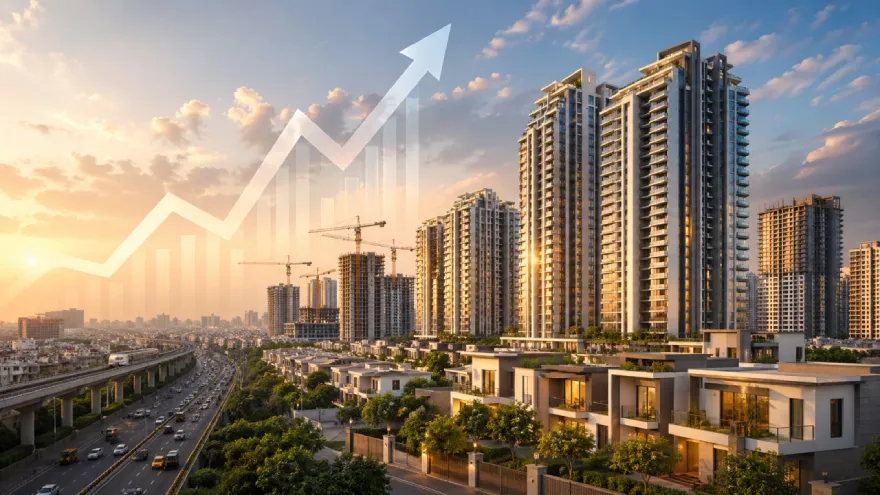
If you haven’t driven along the Outer Ring Road (ORR) lately, you wouldn’t recognize Hyderabad. The cranes dotting the skyline from Kokapet to Tellapur are not just building structures; they are building the future of Indian real estate.
Welcome to 2026. The “Hyderabad Boom” is no longer a prediction whispered by brokers—it is a roaring reality.
We have officially entered the golden era of Hyderabad real estate. While other major Indian metros struggle with saturation and stagnation, Hyderabad has recorded its fifth consecutive year of double-digit appreciation. Here is why 2026 is the year the world is betting on the “City of Pearls.”
1. The “Western Corridor” Has Gone Vertical
Remember when the financial district was just a few office parks? Today, the Western Corridor (connecting Gachibowli, Kokapet, Tellapur, and Mokila) has transformed into a landscape that rivals Singapore’s suburban hubs.
-
The Kokapet Effect: Once dusty farmlands, Kokapet is now the most expensive micro-market in the city. With land prices crossing record highs, luxury high-rises overlooking Gandipet Lake are selling for premiums previously reserved for South Mumbai.
-
Tellapur & Mokila: These have become the playgrounds for the upper-middle class. In 2026, a 200-yard plot in a gated community in Mokila doesn’t just buy you land; it buys you a lifestyle—including international schools, golf courses, and lakeside clubs.
2. Commercial Real Estate: The Job Machine
The residential boom is purely a function of employment. Hyderabad has dethroned Bengaluru as the GCC (Global Capability Center) capital of India.
-
The Future of Work: As of mid-2026, over 60% of new office leases in India are happening in Hyderabad. Amazon, Google, and Apple have tripled their campus footprints.
-
The Infosys Multiplier: With the massive expansion of IT parks along the ORR, the daily commuter traffic has shifted west. This has created a supply crunch—rents in Gachibowli have risen 40% since 2024, forcing investors to buy wherever there is metro connectivity.
3. Infrastructure That Actually Delivers (On Time)
Unlike other cities where infrastructure is a permanent election promise, Hyderabad’s government has cracked the code on execution.
-
Metro Phase II: The extended metro lines connecting the airport to the financial district (and further to Medchal) have turned previously “remote” areas into prime residential zones. Commute times have halved.
-
Regional Ring Road (RRR): With the RRR nearing functional completion, the boundaries of “Greater Hyderabad” have exploded. Investors are looking 30-40 km outward, eyeing the next wave of appreciation.
4. The Luxury Shift (HNI Magnet)
Gone are the days when Hyderabad was known only for “value-for-money” apartments. In 2026, Hyderabad is a luxury market.
Developers are launching “Super Luxury” projects priced above ₹4 Crores ($480,000 USD) and selling them out within weeks. Why? Because the CXOs of MNCs and the founders of unicorns (Hyderabad now has over 30 unicorns) want to live here. They want penthouses with private pools, concierge services, and smart home automation.
The price reality in 2026:
-
Gachibowli/Financial District: ₹12,000 – ₹18,000/sq. ft.
-
Kokapet/Narsingi: ₹10,000 – ₹15,000/sq. ft.
-
Tellapur/Bhanur: ₹7,500 – ₹10,000/sq. ft.
-
Note: Prices in 2021 were roughly half of this.
5. The NRI & IPO Tsunami
The HNIs (High Net Worth Individuals) have arrived. With the startup ecosystem maturing, 2025 saw a record number of IPOs from Hyderabad-based tech firms. The resulting liquidity is flowing directly into land and luxury villas.
Furthermore, NRIs from the US and UK have stopped looking at Dubai as their only investment destination. With the rupee stabilizing and Hyderabad offering rental yields of 4–5% (compared to 2% in global cities), Hyderabad has become the safe haven for foreign remittances.
The Warning Signs (Every Boom has them)
It isn’t all roses. As a buyer, you need to be cautious in 2026:
-
Supply Lag: Demand is outstripping supply. Under-construction projects are seeing delays due to labor shortages (a national issue). If you buy today, possession might be 2029. Always check RERA registration.
-
The “Paper Launch” Epidemic: Because the market is hot, some fly-by-night operators are launching projects without approvals. Stick to Tier-1 developers (My Home, Aparna, Rajapushpa, Phoenix, etc.).
-
Affordability Crunch: Middle-class families are being pushed further out to Shadnagar or Yadadri. The days of finding a 3BHK in the city center for under ₹1 Crore are gone.
Final Verdict: Is it too late to buy in 2026?
No. But you have to be smart.
If you are an end-user looking for a home, don’t wait for a “crash.” With the employment engine this strong, prices will plateau, but they won’t fall. Lock in your home in Tellapur or along the ORR before the RRR triggers the next price jump.
If you are an investor, shift your gaze from the saturated micro-markets. Look at Shadnagar, Yadadri, and Muthangi. These are the Kokapets of 2029. Land prices there are still 30% lower than the peak, but the road widening is already underway.
The Bottom Line: Hyderabad in 2026 is a rare beast in global real estate: high growth, massive rental demand, and political stability. The crane-filled skyline isn’t a bubble—it’s a testament to the city’s relentless momentum.
Are you investing in Hyderabad this year? Tell us which sector you are eyeing in the comments below.